
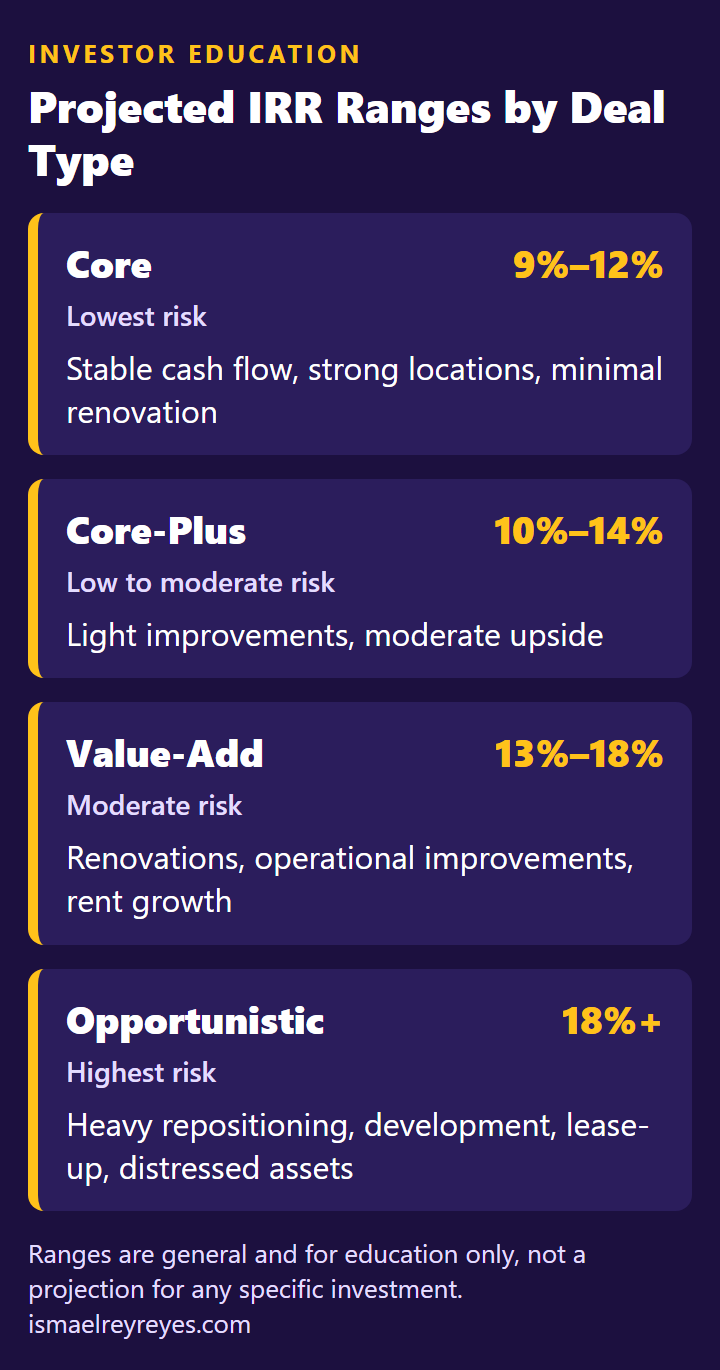
For many value-add multifamily deals, a projected IRR in the low-to-mid teens is often considered solid. Lower-risk core and core-plus deals generally target less, and higher-risk opportunistic strategies target more. A “good” IRR is never universal: it depends on the deal’s risk, timeline, leverage, and exit assumptions.
If you have sat through a sponsor webinar, seen a projected 15% IRR, and wondered what it means for your money, you are not alone.
IRR, or Internal Rate of Return, is the annualized return an investment is projected to generate over its full hold period, accounting for the timing of cash flows. A dollar returned in year one is worth more than a dollar returned in year five, because you can reinvest it sooner. That is why IRR is more useful than a simple average return when you compare one multifamily investment to another.
In practice, IRR reflects three things: when distributions are paid, how large they are, and what happens at refinance or sale. Two deals with the same total profit can produce very different IRRs.


IRR is not a guarantee. It is a projection built on assumptions. A sponsor can make a projected IRR look stronger by assuming faster rent growth, a lower exit cap rate, faster renovations, or a friendlier sale timeline. J.P. Morgan notes that IRR is only as reliable as the assumptions behind projected cash flow and future value.
So a projected 18% IRR is not automatically better than a projected 14% IRR. The lower number may come from more conservative underwriting and a more realistic exit assumption.
The better question is "what is a good IRR for this type of deal?" The market expects higher projected returns as risk increases. NCREIF describes value-add as riskier than core but less risky than opportunistic, and Wharton notes that opportunistic real estate funds often target gross returns in the 16% to 20% range. Sponsor and investor education sources commonly place stabilized and value-add multifamily returns in the low teens to high teens, depending on business plan and hold period.
These are broad rule-of-thumb ranges published by third-party sources, including J.P. Morgan, NCREIF and Wharton. They are not projections, targets, or guarantees for any particular offering.
If a sponsor advertises a 22% to 25% IRR on an ordinary value-add deal in a stable market, slow down and ask which assumptions are doing the heavy lifting.
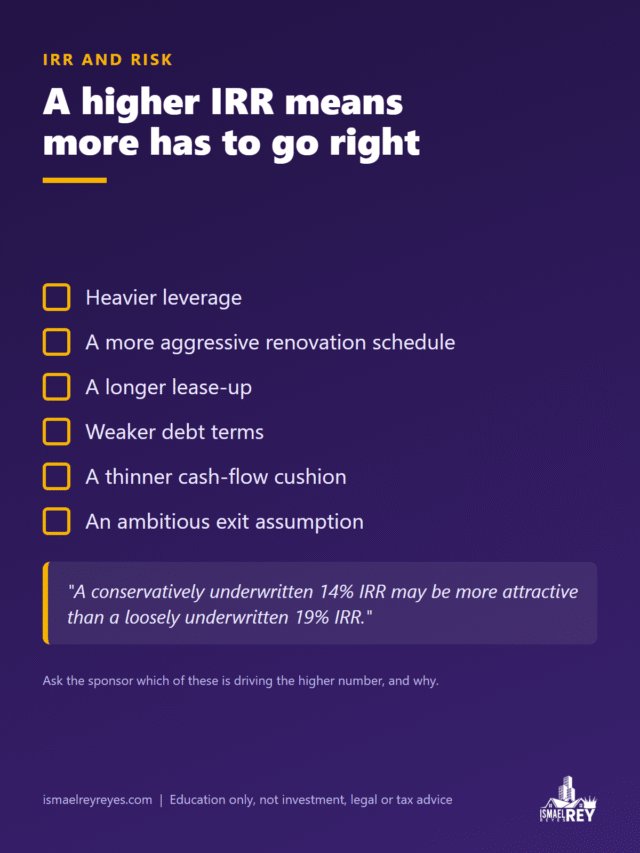
A higher projected IRR should come with a clear explanation of the extra risk: heavier leverage, a more aggressive renovation schedule, a longer lease-up, weaker debt terms, a thinner cash-flow cushion, or an ambitious exit assumption. If the sponsor cannot explain why the target is higher than comparable deals, dig deeper.
For many passive investors, a conservatively underwritten 14% IRR is more attractive than a loosely underwritten 19% IRR. The goal is not the highest percentage. It is understanding what has to go right for that percentage to happen.
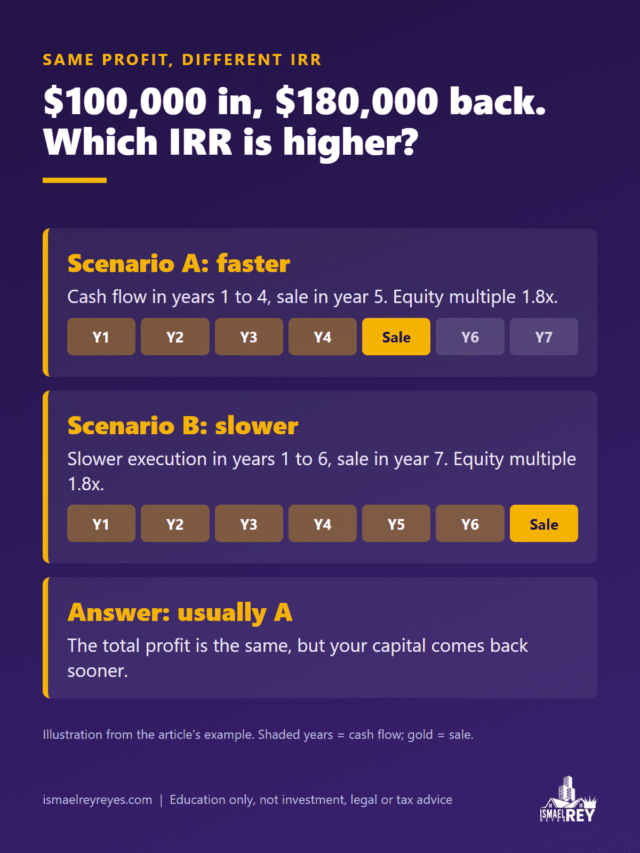
Say you invest $100,000 in two deals and both return $180,000 in total, a 1.8x equity multiple.
Scenario A, faster execution: regular cash flow distributions in years 1 to 4, sale and full return in year 5.
Scenario B, same profit, slower timeline: slower business plan execution in years 1 to 6, sale and full return in year 7.
Scenario A will usually show the higher IRR because your capital came back sooner. Now give both deals the same five-year timeline, but let one sponsor assume a more aggressive sale price at exit. That alone can lift the projected IRR on paper even when current market evidence does not support it. Always ask whether a projected return is driven by operations or by an optimistic exit model.
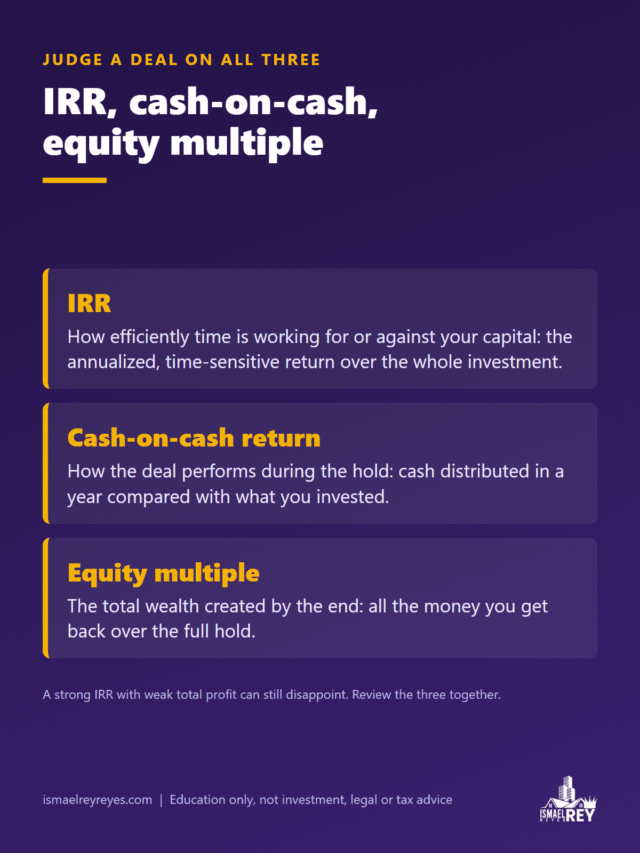
IRR shows the annualized, time-sensitive return over the life of the investment. Cash-on-cash return shows how much cash is distributed relative to invested capital in a given year. Equity multiple shows how much total money you get back over the full hold.
They work together. A deal with a strong IRR but weak total profit can still disappoint. A deal with strong total profit but a long hold can tie up your capital too long. Hold period matters too: a projected 15% IRR over three years is a different deal from 15% over seven, and a short hold may depend on a favorable refinance or sale market arriving exactly on schedule.
New to syndications? Start with this primer on passive multifamily real estate investing.
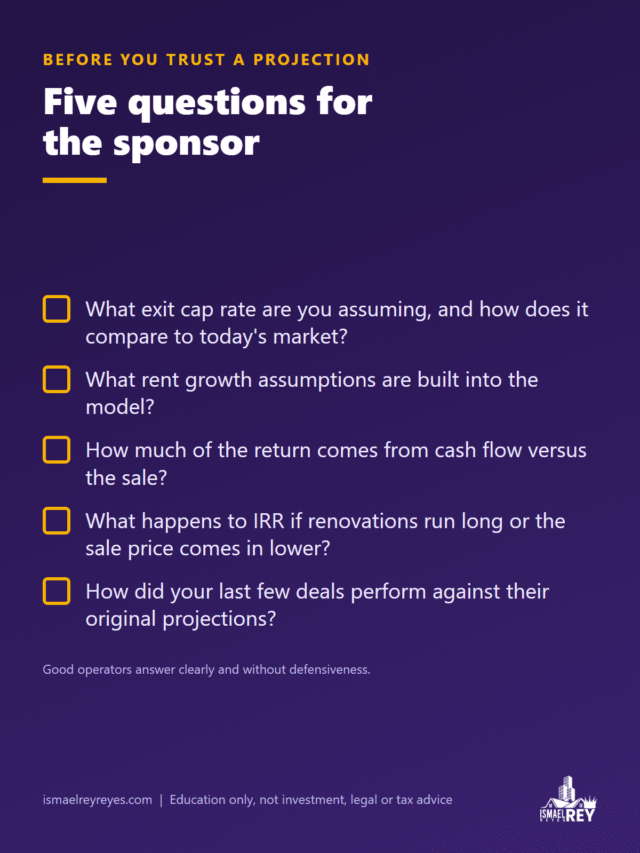
Before investing, ask the sponsor:
Good operators answer clearly and can show how sensitive the deal is to timing, rents, expenses, and exit price. Then verify specifics: full-cycle deals completed, more than one rate or market environment, clear communication when deals underperformed, and conservative assumptions rather than best-case exits. Go deeper on evaluating deals and sponsors in multifamily real estate opportunities.

Multifamily appeals to passive investors because housing stays essential across market cycles, but that does not remove execution risk. The gap between a projected IRR and a realized one usually comes down to underwriting discipline, market selection, debt structure, and sponsor execution.
A good IRR is not one fixed number. For many value-add multifamily deals, a projected IRR in the low-to-mid teens may be perfectly reasonable. Core deals justify lower returns because the risk is lower. Opportunistic deals may target much more, with much more uncertainty. The real question is never "Is this a high IRR?" It is "Are the assumptions behind it credible?" Answer that with confidence and you are evaluating deals like an investor, not reacting to a sales deck.
It can be, but usually only when the deal involves more risk, more aggressive assumptions, or both. That could mean heavier renovations, higher leverage, development exposure, or a less certain exit. Always ask what specifically is driving the projection.
Many newer passive investors are better served by deals with more conservative assumptions, a strong sponsor, and a clear business plan rather than simply the highest projected return. A lower but more credible number is often the better investment.
No. A higher IRR can reflect faster capital return, more risk, or more optimistic underwriting. It should always be evaluated alongside cash-on-cash return, equity multiple, and sponsor quality.
A projected 15% IRR over a three-year hold is very different from the same 15% over seven years. Shorter holds return capital sooner, which lifts IRR, but a short hold may depend on a favorable refinance or sale market arriving exactly on schedule. Compare the timeline, business plan, and exit path, not just the percentage.
The content above is provided for educational and informational purposes only. It does not constitute financial, investment, or legal advice, and it is not an offer to sell or a solicitation of an offer to buy any security. Return ranges cited are general third-party market benchmarks, not projections or guarantees for any particular investment. Readers are encouraged to conduct their own research and consult with a licensed professional before making any decisions. The views and opinions expressed are those of the author and do not necessarily reflect the official policy or position of any affiliated organization.