
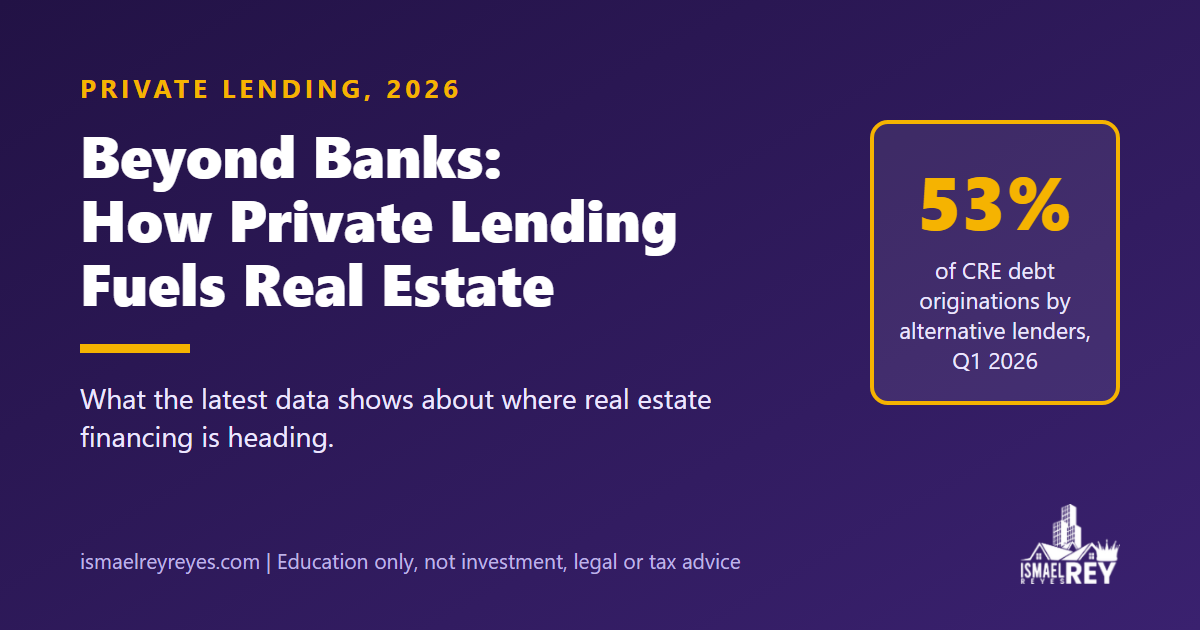
Quick Answer Summary: Private lending means borrowing from a source other than a traditional bank, with the loan secured by the property itself. In Q1 2026, alternative lenders handled 53% of commercial real estate debt originations while banks handled only 22%, though banks are returning and private credit is cooling from its peak.
Private lending for real estate investors has moved from a niche option to a major source of real estate financing. For years, banks were the default answer when an investor needed capital. Today, tighter regulation, refinancing pressure and a stricter appetite for complex deals have pushed a growing share of real estate loans toward private lenders, alternative lenders and private credit funds. This guide explains what is changing, what the latest data shows and what it could mean for investors who want to understand where real estate financing is heading.
Private lending means borrowing from a source other than a traditional bank, such as an individual, a specialty lender or a debt fund. The loan is secured by the property itself, which is why this style of financing is often called asset-based or hard money lending. Common products include bridge loans, fix-and-flip loans, construction loans and DSCR loans, which underwrite on a property's cash flow rather than the borrower's personal income.
Because the property and its equity usually carry most of the weight in the decision, private lenders can approve borrowers that banks often decline, though these loans typically cost more than bank financing.
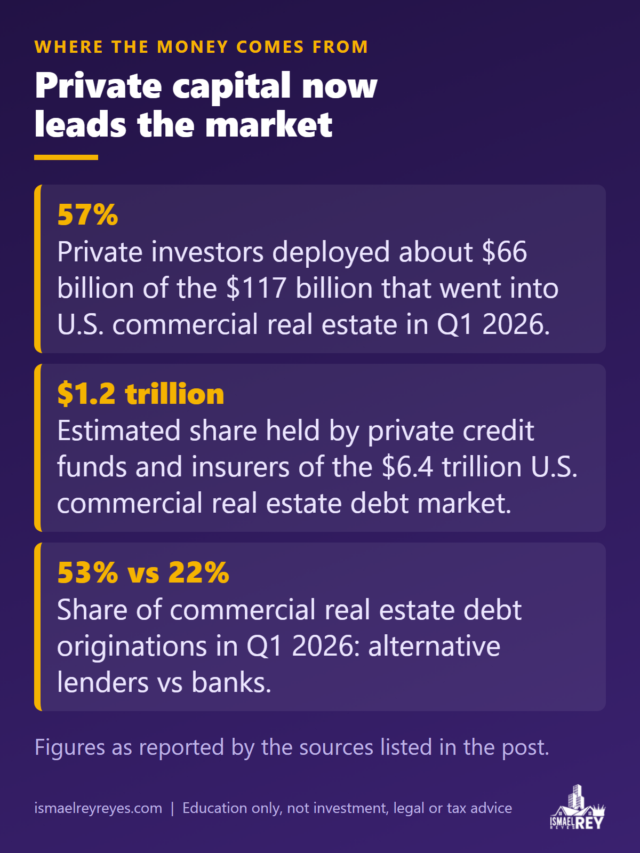
Industry data shows private investors deployed about $66 billion into U.S. commercial real estate in Q1 2026, roughly 57% of the $117 billion total volume. On the debt side, estimates put private credit funds and insurers at about $1.2 trillion of the $6.4 trillion U.S. commercial real estate market. A lending index also found that alternative lenders handled 53% of commercial real estate debt originations in Q1 2026, while banks handled only 22%.
In plain terms: the capital that used to flow through bank branches now flows increasingly through debt funds, specialty lenders and private individuals.
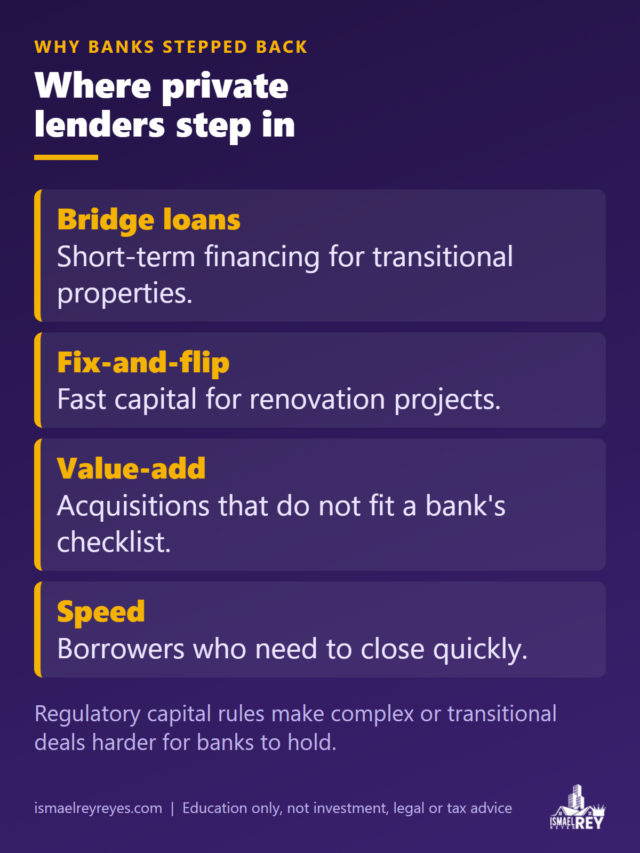
Industry reporting attributes the shift to regulatory capital constraints that make complex or transitional deals harder for banks to hold, which opens the door wider for private credit. That is the segment where private lenders tend to be most active: bridge loans, fix-and-flip projects, value-add acquisitions and borrowers who need to close quickly. For investors, it means more financing options for deals that do not fit a bank's checklist.
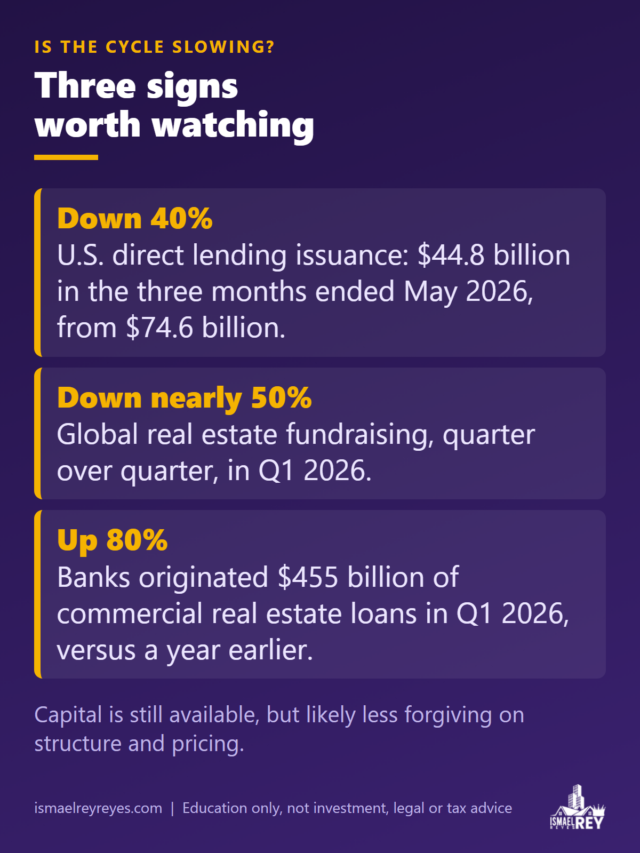
Any honest look at the real estate lending market should include the signs of slowing:
The takeaway from commentators is that capital remains available, but it is likely to be less forgiving, with more scrutiny on structure and pricing. In other words, the market is maturing, and quality of underwriting matters more than speed alone.
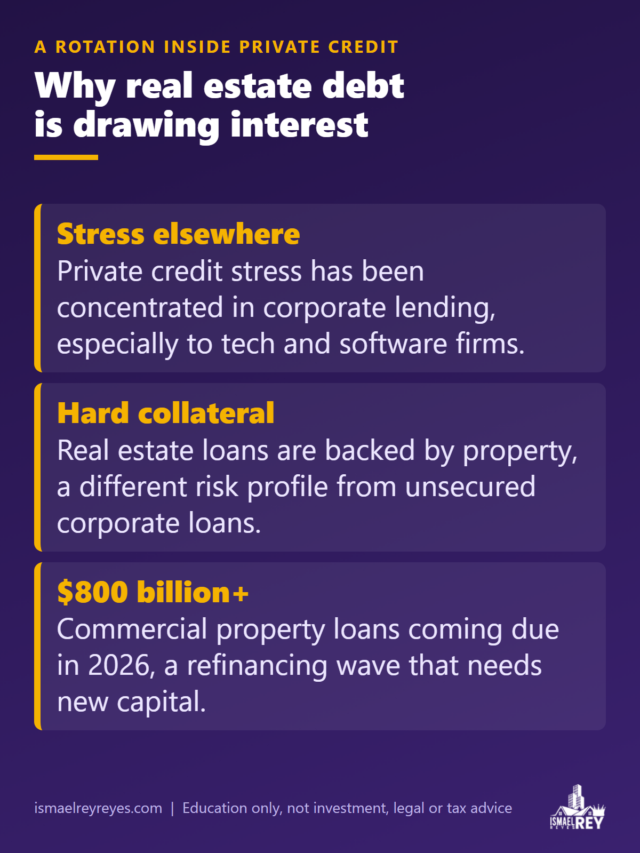
One of the more interesting recent trends is a rotation within private credit itself. Market coverage in June 2026 noted that stress in private credit has been concentrated in corporate lending, particularly loans to technology and software firms, while investors are looking at real estate debt for its hard collateral and steady payouts. The same coverage notes that more than $800 billion in commercial property loans come due in 2026, a refinancing wave that could create steady demand for new capital.
For anyone evaluating this space, asset-backed real estate loans carry a different risk profile from unsecured corporate loans, which is worth understanding clearly.
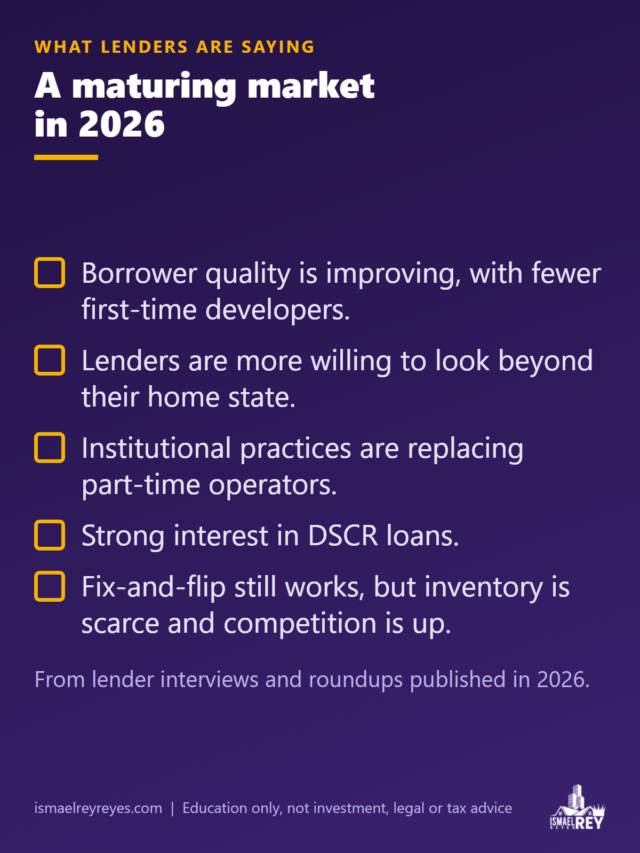
Interviews with private lenders published this year paint a consistent picture of a maturing market:
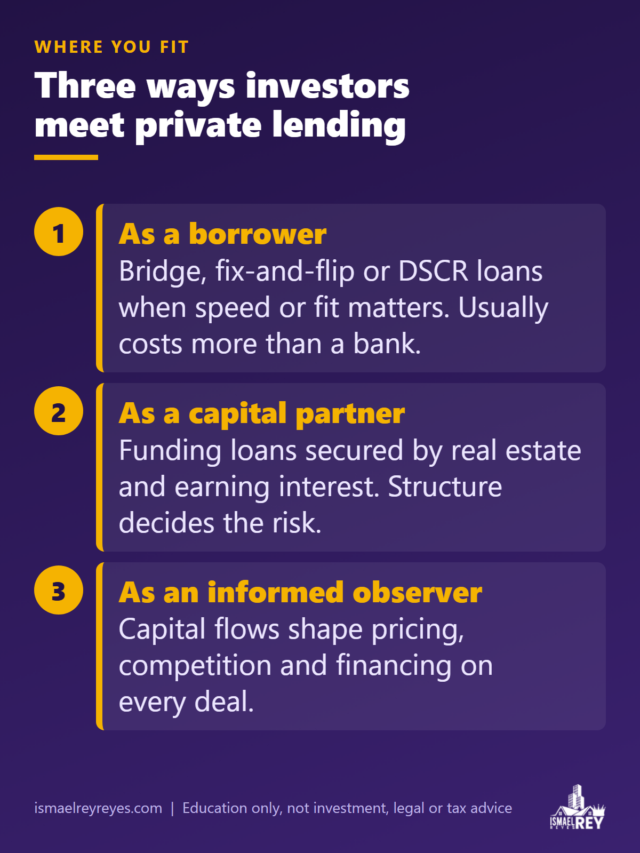
Private lending touches real estate investors in a few different ways, and it helps to know the difference:
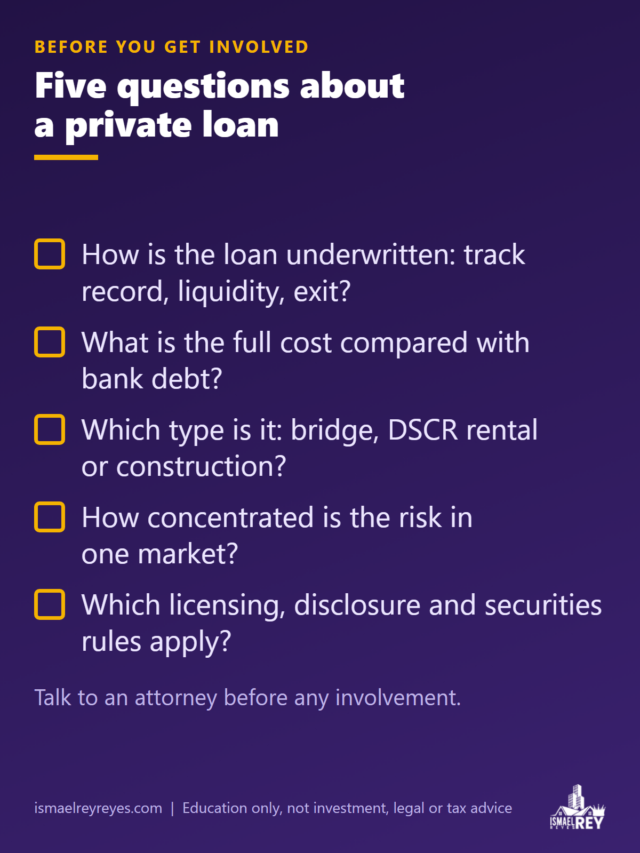
For readers who want to explore this space further, these are the kinds of questions worth working through:
It is different rather than simply riskier. Loans are secured by real estate, but they usually cost more, terms tend to be shorter, and outcomes depend on underwriting quality, leverage and the borrower's exit plan. Lending and investing involve risk, including loss of principal.
A DSCR (debt service coverage ratio) loan is an investment property loan underwritten on the property's rental income rather than the borrower's personal income.
Yes. Banks originated $455 billion of commercial real estate loans in Q1 2026, up 80% from a year earlier, so banks are returning even as private lenders hold a large share of the market.
Licensing, disclosure and securities rules vary by state and by whether someone lends their own money or pools investor capital. An attorney can explain what applies in a specific situation.
Banks are returning, private credit is cooling from its peak and borrowers are more experienced. The result is a real estate financing market that is more professional and more selective than it was a few years ago. The takeaway is not that every investor should move into private lending. It is that private lending has become a significant part of how real estate gets financed, with a large wave of loans coming due and continued demand for capital. Understanding how it works, what it costs and where the risks sit puts investors in a better position to decide whether it has any role in their own strategy.
Want to keep learning about real estate financing? Follow the blog for more guides on private lending, bridge loans and investment property financing.
Disclaimer: This post is for general information only and is not legal, tax or investment advice. Lending and investing involve risk, including loss of principal.
Sources and further reading
Statistics are as reported by the linked sources and their underlying data providers.
The following content is provided for educational and informational purposes only. It does not constitute financial, investment, or legal advice. Viewers are encouraged to conduct their own research and consult with a licensed professional before making any decisions. The views and opinions expressed are those of the presenter and do not necessarily reflect the official policy or position of any affiliated organization.