
If you want a real estate strategy that can support steady income, long-term appreciation, and more freedom over time, multifamily real estate investment deserves serious attention. Unlike assets that depend on a single tenant or short-term speculation, multifamily properties are built around a basic need: housing. That gives investors a more durable foundation for cash flow, resilience, and long-range wealth creation. For many U.S. investors, it is one of the clearest paths to financial independence.

At its core, multifamily real estate investment stands out for its ability to spread risk across multiple income-producing units. If one resident moves out, the property may still generate revenue from the remaining units. That is very different from a single-unit property, where one vacancy can reduce income to zero.
Multifamily also gives investors a more scalable model. Instead of buying one house at a time and repeating the same management challenges across scattered locations, investors can build efficiency around one professionally managed property. That often improves operations, lowers per-unit costs, and creates more consistent performance over time.

Just as important, multifamily investing aligns with the disciplined, research-driven approach your website emphasizes: careful due diligence, conservative underwriting, professional property management, trustworthy operators, and long-term thinking instead of short-term hype.
A few of the biggest reasons investors stay drawn to this asset class include:
Multiple income streams that can reduce vacancy risk
Economies of scale that can improve operational efficiency
Professional management that can make ownership more consistent and less stressful
Long-term appreciation potential that can compound wealth over time
Diversification within one asset can strengthen resilience
One reason this topic is getting more attention in 2026 is that the market backdrop is changing in ways investors should watch closely. New apartment deliveries fell roughly 30% year over year in the first quarter of 2026, construction activity dropped to its lowest level since 2016, and national vacancy stayed relatively stable as demand normalized. That combination suggests supply pressure is starting to ease after the post-pandemic construction wave. Cushman & Wakefield
At the same time, affordability challenges in the for-sale housing market continue to keep many households in the renter pool. Elevated home prices, higher mortgage rates, and limited inventory have widened the gap between owning and renting, while demographic trends and longer renter tenure continue to support apartment demand. Morgan Stanley
That broader affordability pressure is showing up across the housing market. Harvard’s Joint Center for Housing Studies reported that renter cost burdens hit another record high, while the high cost of homeownership helped support renter household growth even as demand cooled from its earlier peak. For long-term buyers, multifamily real estate investment is especially relevant when housing demand remains strong and new development slows. Harvard JCHS
Here are some of the most relevant market signals investors should be paying attention to:
New apartment deliveries declined about 30% year over year in Q1 2026 Cushman & Wakefield
New construction starts have fallen sharply, thinning the medium-term pipeline Morgan Stanley
Homeownership affordability remains strained, helping keep more households renting Morgan Stanley
Rental affordability pressures remain widespread, reinforcing how essential well-run housing supply still is Harvard JCHS
For investors focused on sustainable growth, that combination matters. It suggests multifamily is not just a short-term income play. It can be a long-horizon asset class supported by housing demand, demographic pressure, and real-world affordability trends.
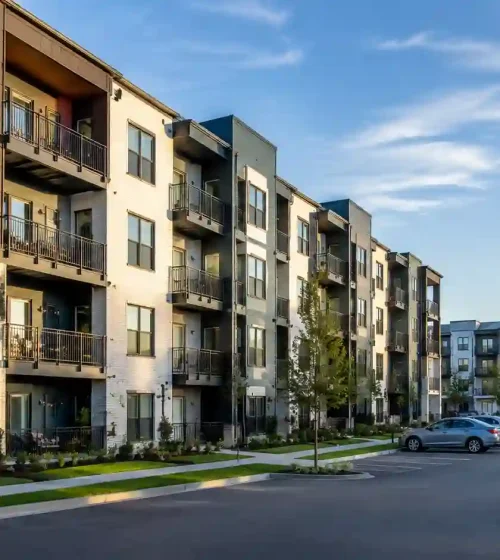
The most practical reason investors pursue multifamily is recurring income. Monthly rent payments can create a stream of cash flow that helps cover expenses, build reserves, and eventually supplement earned income. Over time, that income can become a powerful part of a broader wealth strategy.
For investors who do not want to handle tenant calls, maintenance coordination, or day-to-day property issues, passive real estate investing can offer exposure to real estate performance without the direct landlord burden. That is one reason multifamily is so attractive for professionals, retirees, and business owners who want ownership benefits without creating another full-time job.
One of multifamily’s long-term advantages is its ability to reprice rents more frequently than many other property types. When inflation pushes up wages, insurance, repairs, or replacement costs, shorter lease durations can allow owners to adjust rents more regularly than assets tied to long fixed leases. Morgan Stanley specifically highlights multifamily’s relatively short lease structure as one reason the sector can reprice more effectively in rising-cost environments. Morgan Stanley
That does not mean rents automatically rise in every market. It means multifamily has a built-in mechanism that can help investors protect income over time. In an uncertain economy, that flexibility can make a meaningful difference.
Many people want the benefits of real estate without the friction of active management. That is where passive multifamily investing becomes especially attractive. Instead of self-managing units, passive investors can partner with experienced operators and let professionals handle acquisitions, asset management, and property operations.
This model can be especially appealing if your goal is multifamily passive income that fits around a busy career, military service, family life, or retirement planning. Rather than trading more hours for more income, investors can focus on selecting the right market, team, and business plan.


That does not remove risk, and it does not guarantee returns. But it does create a path for investors to pursue real estate exposure with less day-to-day friction and greater emphasis on due diligence, communication, and long-term alignment.
Hands-off ownership tends to appeal to investors because:
Experienced operators can manage execution
Diversification may be easier through pooled capital structures
Ongoing reporting and transparency matter just as much as projected returns
Investors can stay focused on strategy rather than daily operations
Strong blog content in 2026 is no longer just about listing benefits. Readers want practical decision-making guidance, and that is where this topic becomes genuinely useful.
Before making any commitment, investors should evaluate:
Sponsor track record: How many deals has the team managed, and how have past assets performed?
Market selection: Is the area supported by job growth, population trends, and durable renter demand?
Underwriting discipline: Are rent growth, expenses, and exit assumptions conservative and realistic?
Property management quality: A strong management team can protect occupancy, retention, and asset value
Communication standards: Investors should understand how often updates are shared and how transparent the team is
Business plan clarity: The value-creation strategy should be simple, measurable, and well explained
Tax and exit strategy: Investors should know how income, depreciation, refinance, and disposition may affect returns
This is where good investing separates itself from marketing. Long-term success in multifamily real estate investment usually comes from disciplined selection, patient execution, and alignment with experienced professionals who communicate clearly and underwrite responsibly.


A lot of investors are attracted to multifamily for the right reasons, but they still make avoidable mistakes. The most common issues usually include chasing aggressive projections, ignoring management quality, skipping proper due diligence, or concentrating too much capital in one weak market.
Long-term growth is usually built through consistency, not excitement. Investors who tend to perform well over time usually prioritize:
Cash flow durability over flashy projections
Market quality over hype
Operator trustworthiness over polished marketing
Long-term strategy over short-term noise
Risk-adjusted returns over unrealistic promises
That mindset is especially important for investors using this approach as part of a broader wealth plan. Passive ownership does not mean careless ownership. It means your role shifts from managing units to evaluating opportunities intelligently.
For U.S. investors who want steady cash flow, long-term appreciation potential, inflation resilience, and a realistic path toward financial freedom, multifamily real estate investment remains one of the strongest strategies to consider. It is not about chasing shortcuts. It is about owning an asset tied to real housing demand, managed with discipline, and structured for sustainable growth. When approached thoughtfully, it can become a powerful foundation for long-term wealth and independence.
The following content is provided for educational and informational purposes only. It does not constitute financial, investment, or legal advice. Viewers are encouraged to conduct their own research and consult with a licensed professional before making any decisions. The views and opinions expressed are those of the presenter and do not necessarily reflect the official policy or position of any affiliated organization.