
Quick Answer Summary: A preferred return in real estate is a priority position, not a guarantee. It is the return investors (LPs) receive before the sponsor (GP) shares in profit, inside a payout order called a distribution waterfall. Two terms decide what it is worth: whether the pref is cumulative, and whether an unpaid balance compounds.
Most passive investors hear "8% preferred return" in a webinar and assume it works like a bond coupon: a fixed check, on schedule. It doesn't. A preferred return is one tier inside a larger payout structure called a waterfall, and where your money sits in that structure decides whether you get paid in a slow year.
A distribution waterfall is the order in which available cash is paid out. Cash flows down through tiers, and each tier fills before the next one gets anything. On one side are the limited partners (LPs), the passive investors who put in the capital. On the other is the general partner (GP), the sponsor who finds, underwrites and manages the deal.
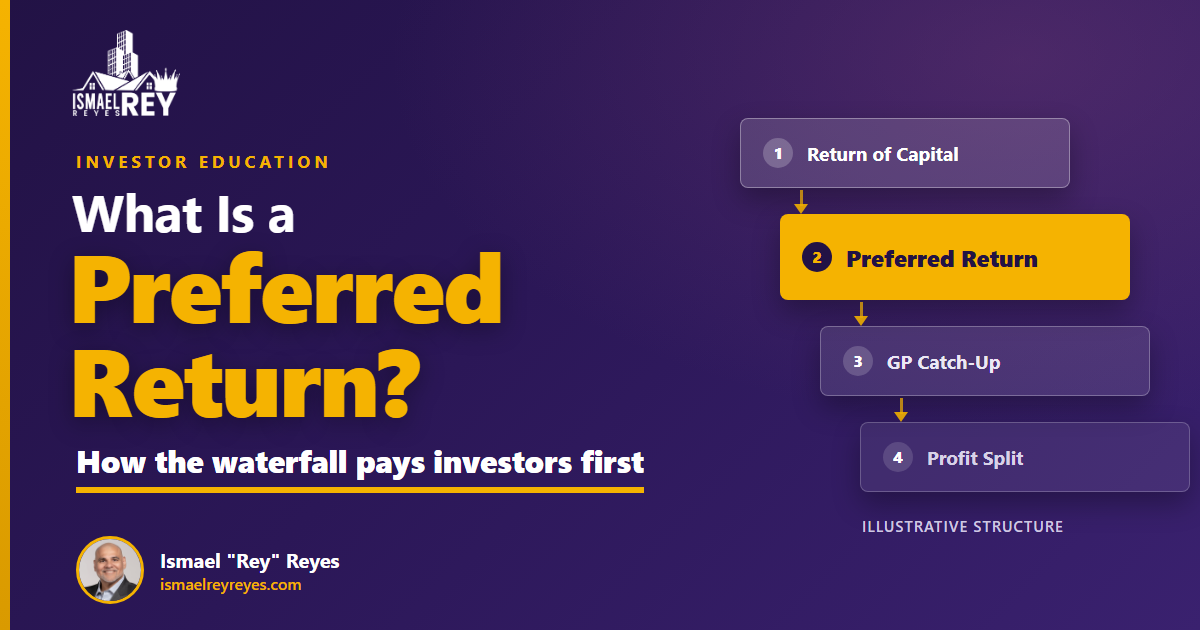

A preferred return (often "the pref") is the minimum return LPs receive before the GP shares meaningfully in profit. It is commonly set somewhere from the mid-single digits to about 8%. The exact rate is set deal by deal and disclosed in the offering documents.
What it is: a priority position. LPs get paid ahead of the GP's profit share.
What it is not: a guarantee. A pref is not a bond coupon, and it is not insured or secured. If the property doesn't produce enough distributable cash in a year, the pref isn't paid that year. "Preferred" describes payment order, not payment certainty.
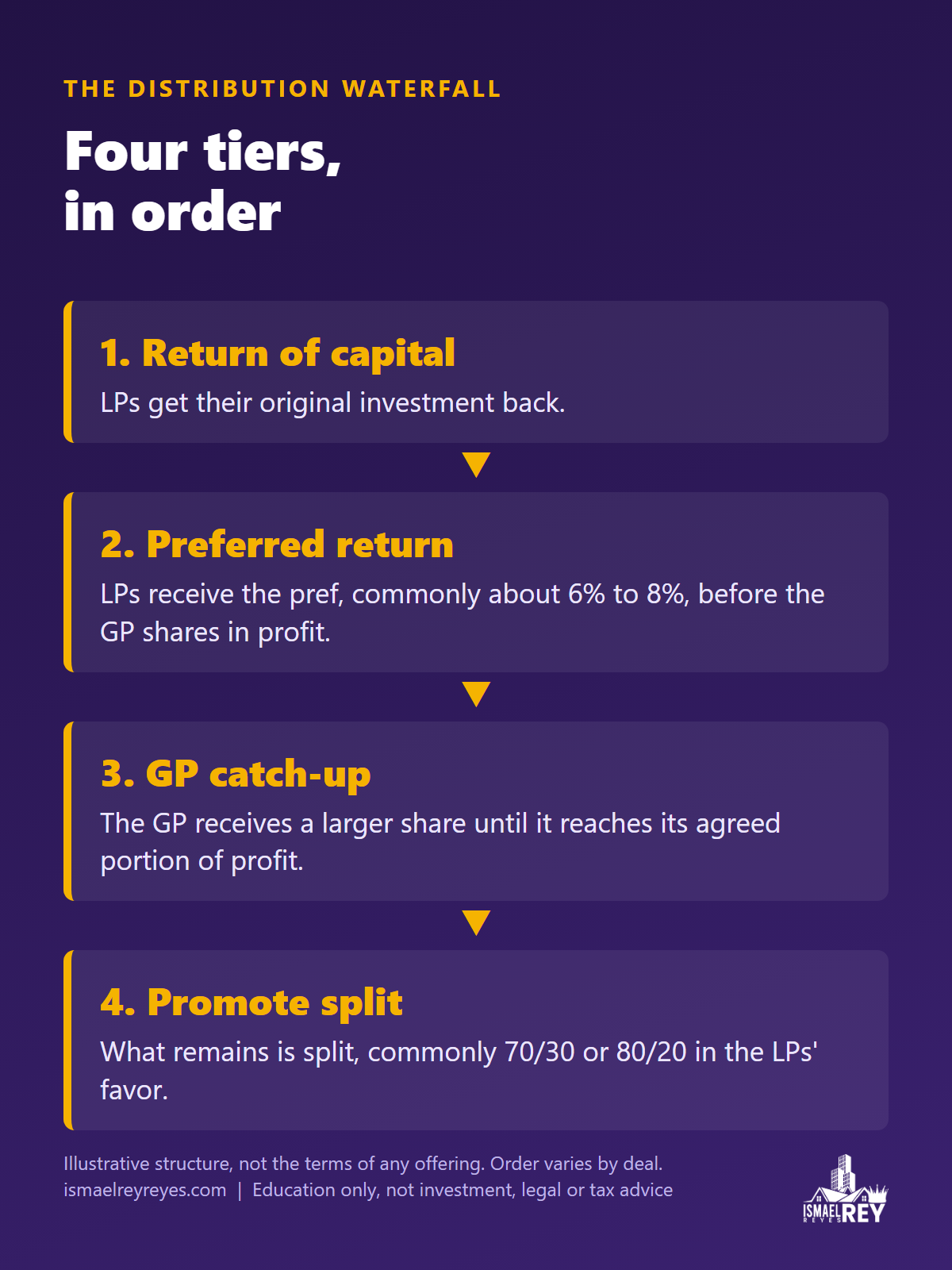
Most waterfalls combine these tiers:
The order of the first two tiers varies: many deals pay the pref from operating cash flow each year and return capital at a sale or refinance. These are illustrative structures commonly seen in the market, not the terms of any offering. Each deal's actual waterfall is in its Private Placement Memorandum (PPM) and operating agreement.
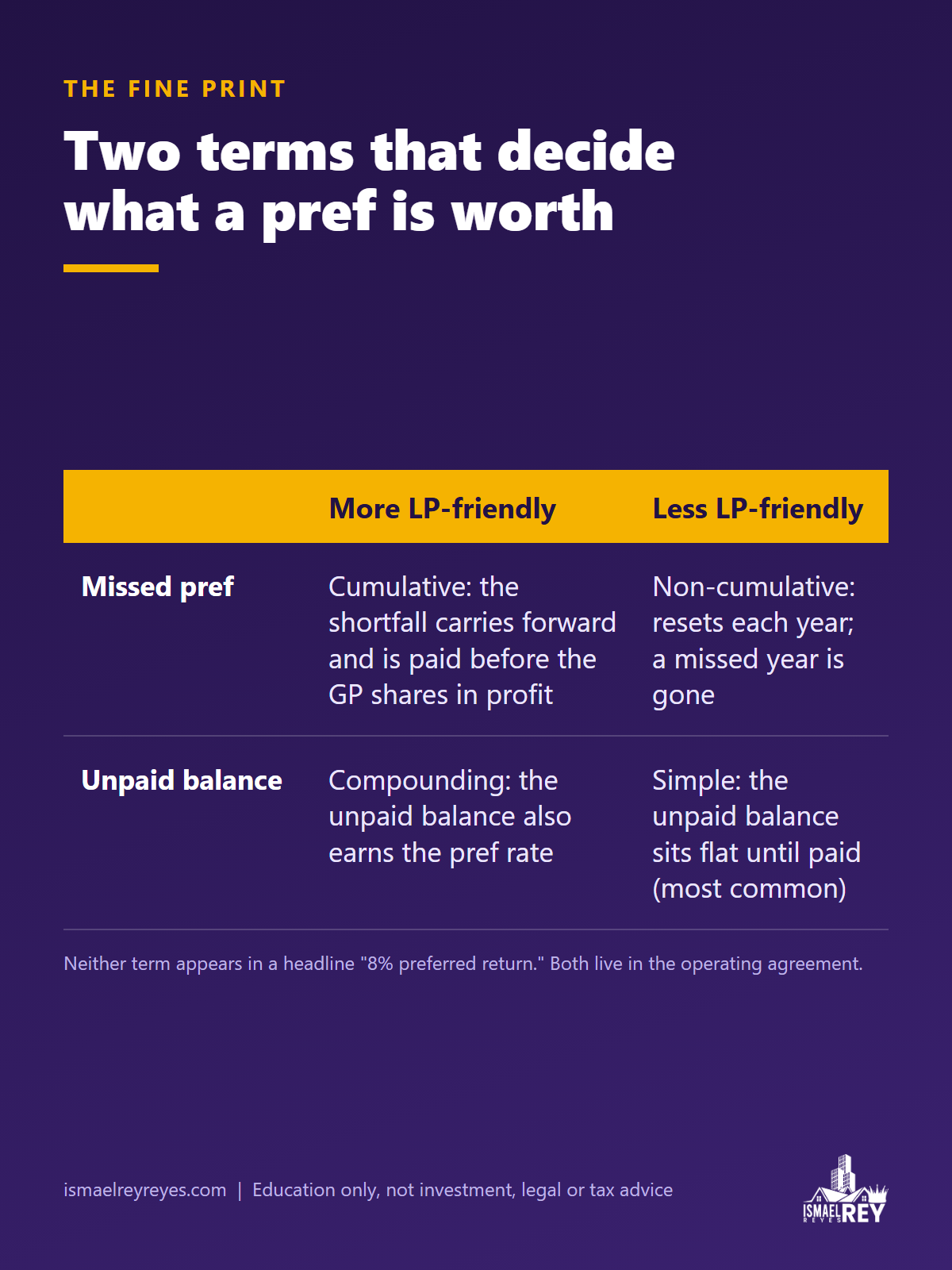
Two distinctions matter more than the headline percentage.
Cumulative vs. non-cumulative. A cumulative preferred return accrues. If the deal doesn't pay the full pref in a year, the shortfall carries forward and must be paid before the GP shares in future profit. A non-cumulative pref resets each year, so a missed year is gone. Cumulative is materially more investor-favorable, and it is easy to skim past in a PPM.
Compounding vs. simple. On a cumulative pref, does the unpaid balance also earn the pref rate (compounding), or sit flat until paid (simple)? Most deals use simple accrual. Compounding is less common and more LP-favorable, so confirm it rather than assume it.
Neither term shows up in a pitch deck's "8% preferred return" line. Both live in the operating agreement.
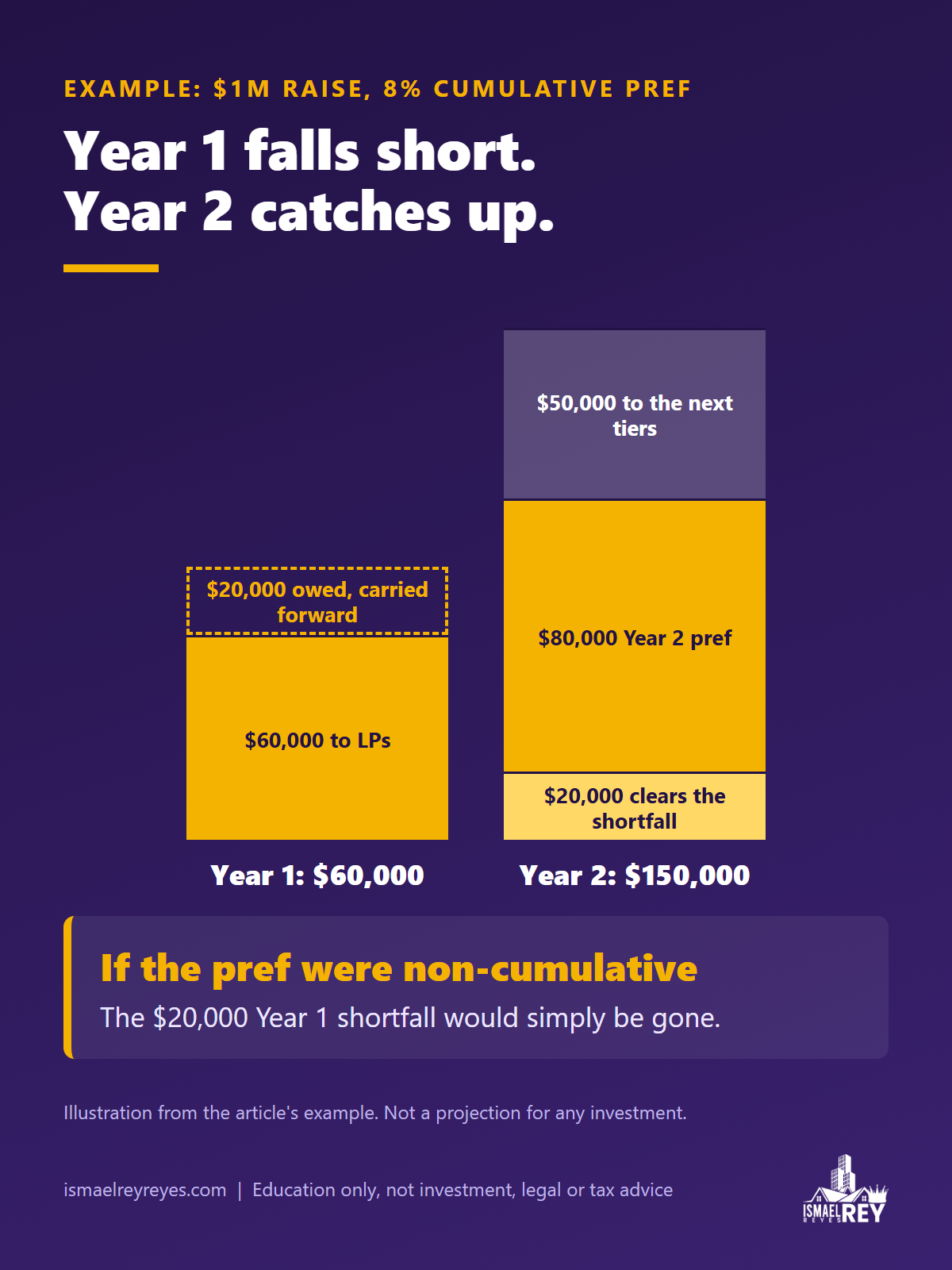
Say a deal raises $1,000,000 with an 8% cumulative preferred return and a 70/30 split above the pref.
Year 1: the property distributes $60,000, short of the $80,000 pref. All $60,000 goes to LPs, and the $20,000 shortfall carries forward.
Year 2: the property distributes $150,000. The first $20,000 clears last year's shortfall, and the next $80,000 covers this year's pref. The remaining $50,000 moves to the next tiers and is split according to the agreement.
Under a non-cumulative pref, the Year 1 shortfall would simply be gone. That is the difference one word in the PPM makes.

The waterfall isn't marketing copy. It is a binding section of the PPM and operating agreement, usually titled "Distributions" or "Allocations." Read that section slowly, not the summary slide. It should spell out the pref rate, whether it is cumulative, whether it compounds, the catch-up and the final split.
A sponsor's projected IRR or equity multiple comes out of that waterfall. The same total profit pays LPs differently through a cumulative pref and an 80/20 split than through a non-cumulative pref, a 70/30 split and an aggressive catch-up, even when the property performs the same. So ask how a projected return was modeled, not just what the number is.
Slow down if you see:
Then ask the sponsor the five questions in the checklist. None of these red flags is automatically disqualifying, since waterfalls vary by strategy and risk. But a sponsor who can't explain their own waterfall clearly is telling you something. For more on vetting the people behind a deal, see 5 red flags to spot before choosing a multifamily investment sponsor.
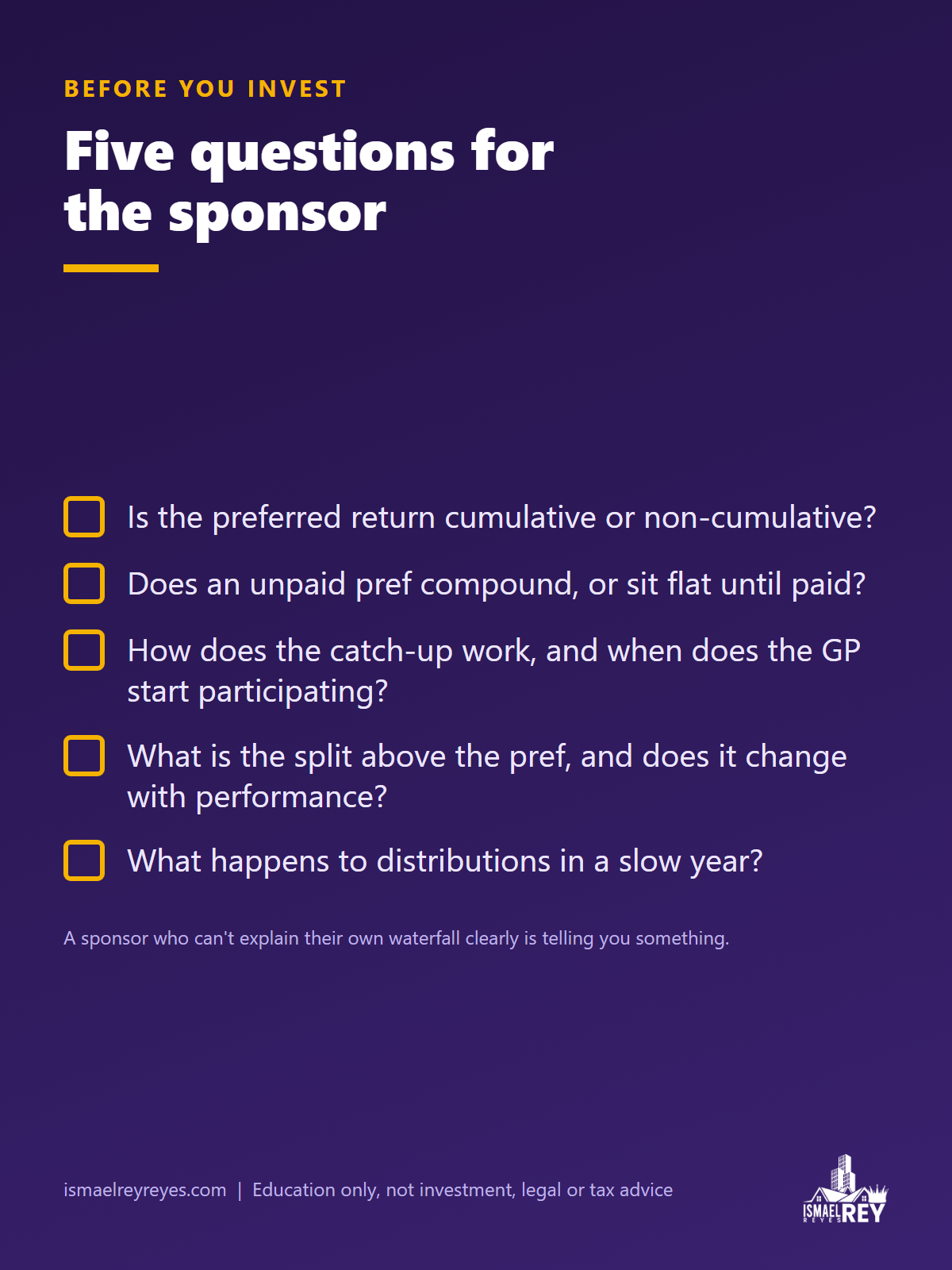

The percentage on the pitch deck is the headline. The waterfall decides who gets paid, in what order, and what happens when a year underperforms. Cumulative versus non-cumulative and compounding versus simple are often the difference between a pref that protects you in a soft year and one that just resets.
Before wiring capital, ask to see the distribution section of the operating agreement, and ask the sponsor to walk you through it in plain language. If they can, that's a good sign. If they can't, that's information too.
Newer to syndications? Start with passive multifamily real estate investing 101, then exploring multifamily real estate opportunities.
No. It is a priority position in the payout order, not a guaranteed payment. If the property doesn't generate enough distributable cash, the pref may go unpaid for that period. What happens next depends on whether it is cumulative.
Structures vary by deal and sponsor, but a commonly seen range is roughly 6% to 8%. That is a general market pattern, not a commitment for any offering. Always confirm the actual rate in the deal's documents.
A preferred return is a payout priority threshold inside the waterfall. IRR is a time-weighted measure of the investment's annualized return over the full hold. A deal's IRR is the result of running its cash flows through the waterfall.
In the Private Placement Memorandum and the operating agreement, usually under "Distributions" or "Allocations." If a sponsor can't point you to that section, ask why.
The following content is provided for educational and informational purposes only. It does not constitute financial, investment, or legal advice. Viewers are encouraged to conduct their own research and consult with a licensed professional before making any decisions. The views and opinions expressed are those of the presenter and do not necessarily reflect the official policy or position of any affiliated organization.